Every time I talk about agricultural biotechnology in Bangladesh, I start with a simple truth: food security here is a daily battle.
We are a nation of more than 175 million people living on land the size of New York State. Climate shocks, pests, and rising input costs all threaten our smallholder farmers — the backbone of our food system. And yet, for many years, fear and misinformation stood in the way of practical solutions.
When I founded Farming Future Bangladesh (FFB), my mission was clear:
fight fear with evidence, amplify science, and empower communities to choose innovation confidently.
Real Challenges, Real Innovations
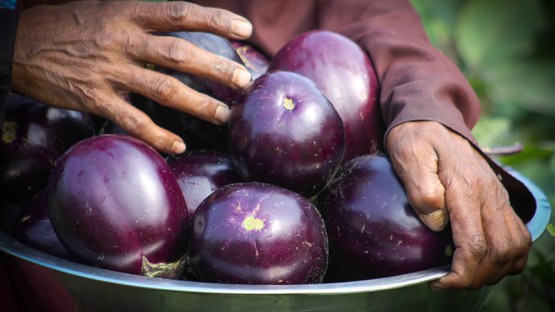
Bangladesh faces relentless challenges: heavy pest pressure on brinjal, a climate that invites late blight on potatoes, and nutritional deficiencies rooted in our staple foods. So when public-sector scientists partnered with Cornell and USAID to develop Bangladesh’s first biotech crops, it felt like a breakthrough.
And the results have been powerful:
- Bt brinjal is now grown by more than 65,000 farmers, who report higher yields, six-fold income increases, and far fewer pesticide sprays.
- Golden Rice, engineered with beta-carotene, offers a new way to tackle vitamin A deficiency.
- Late blight–resistant 3R gene potatoes show dramatic success in trials — literally forming “green islands” of healthy plants surrounded by diseased conventional fields.
- GM Bt cotton, approved for trial, holds promise for our massive textile industry.
These innovations didn’t come from corporations—they came from public institutions serving farmers. But despite the benefits, mistrust remained.
The Shock That Changed My Strategy
In 2019, we conducted a national perception study. The results stunned me:
73 per cent of Bangladeshis had never even heard the term GMO.
How do you address “controversy” around something people don’t know exists?
And among the minority who had heard of it, reactions weren’t simple. People were worried about health risks, environmental impacts, political motives, and government transparency. I realized something important:
This wasn’t ignorance. This was confusion. And confusion leaves space for misinformation.
So I rethought our approach completely.
Building Our 3D Impact Strategy
We developed what I call the 3D Impact Strategy—a model built on three pillars:
1. Share Clear Evidence
Information must be accessible, local, and relevant.
So we took journalists, policymakers, donors, and youth straight to farmers’ fields. They heard directly from real growers saying things like:
“I used to spray pesticides 80–100 times a season. Now I barely spray at all.” No scientific paper can match the power of a farmer’s voice.
2. Engage Influential Messengers
Reaching 175 million people myself is impossible. But reaching influential groups—who then reach their own communities—is not.
So we worked with:
- journalists
- scientists
- nutritionists
- extension workers
- youth leaders
- women’s groups
- and importantly, faith leaders
These groups shape public opinion in ways that scientists alone cannot.
3. Empower Communities
Knowledge shouldn’t be top-down.
We trained students at 17 universities, supported youth campaigns, and gave journalists fellowships to investigate biotech issues. We made sure the next generation had the tools to communicate science responsibly.
Our Most Unexpected Allies: Faith Leaders
One of the most transformative lessons in my journey was realizing how much influence imams and faith leaders have in shaping public trust. A scientist can explain gene expression, but an imam can explain values: safety, stewardship, community welfare.
We helped over 500 faith leaders who now speak about science, agriculture, and innovation in ways that resonate deeply with ordinary people. One sermon can reach hundreds—sometimes thousands—of listeners.
Reaching People Where They Are
To reach more people, we expanded beyond field visits and workshops:
- I hosted a 108-episode weekly TV talk show during COVID-19.
- We created a weekly radio program with 3,500+ listener responses.
- We launched social campaigns across Bengali and English media.
- We built the first pro-GMO policy alliance in the country, connecting institutions that had never spoken to each other before.
These efforts weren’t about “selling” technology. They were about making people feel heard, respected, and informed.
Why We’re Building a Global South Movement
As I connected with colleagues in Africa, Asia, and Latin America, one pattern became clear: our challenges are shared.
- Misinformation
- Climate vulnerability
- Nutritional deficiencies
- Regulatory bottlenecks
- Distrust in institutions
So together with the Alliance for Science, we helped launch the Global South Hub Asia to link our experiences and stand stronger together. Science shouldn’t be isolated by borders; neither should trust.
Hope Is Stronger Than Fear
If there’s one thing I’ve learned from my work, it’s that fear thrives in silence—but hope thrives in conversation.
Every time a farmer tells me,
“This seed changed my life,”
I’m reminded why this work matters.
Every time a young person says,
“I didn’t know science communication could look like this,”
I see the next generation stepping up.
And every time a faith leader says,
“Let me explain this to my community,”
I know we’re finally speaking a language people trust.
Biotechnology is not just about crops.
It’s about dignity, health, livelihoods, and the simple human hope of a better tomorrow.
And that hope—rooted in science, strengthened by trust—is what keeps me committed to this work every day. _______________________________________________________________________________________________
Md Arif Hossain is an Alliance for Science Fellow and the Executive Director of Farming Future Bangladesh.